By Sarah Taylor
This week’s reading feels like an alliance to me — or more accurately, a truce, because it doesn’t seem to be an entirely easy one. This isn’t so much because the two parties, or aspects, are ones that are traditionally at war with each other; rather, they are too dissimilar to create a neat fit.
That being said, they have decided to work together, whether simply for a period or time or for a specific purpose. There is a feeling of ‘agreeing to disagree’ that enables both parties, or aspects, to co-operate in order to effect an equilibrium. Let’s look at the contrast created by the first two cards, and see how they are brought together in the third.

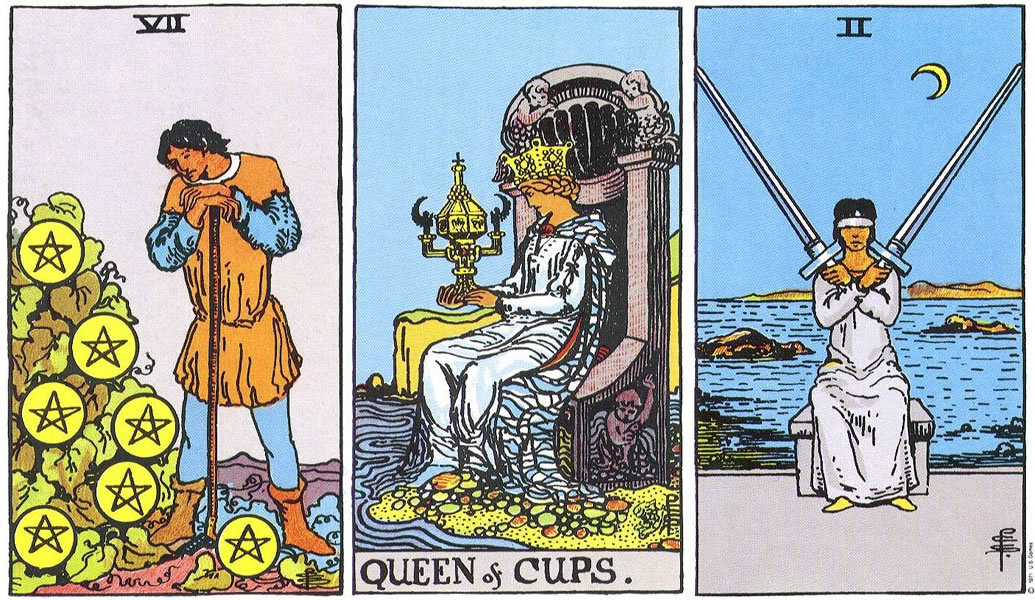
7 of Pentacles, Queen of Cups, 2 of Swords from the Rider-Waite Smith Tarot deck. Click on the image for a larger version.
Pentacles are traditionally associated with the physical world and how we choose to operate in it. In the 7 of Pentacles, a man stands in a vineyard, chin resting on a long-handled tool that he has been working with, surveying the product of his labours — seven pentacles which hang like fruit in the vines before him. He seems tired. He has worked hard to get to this stage. It feels hot: the sky is clear — not a cloud in sight to offer any shade — and, apart from the vines, there is little sign of greenery around him. It is as if he has been rearing his crop in an arid landscape, against the odds. Yet he has met with success in spite of this. It reminds me of the vintners in areas such as California, Australia and South Africa, who not only have to work with nature in order to ensure their crops, but also have to work against it, diverting rivers and creating reservoirs to irrigate land that would otherwise be water-less.
Now we have a pause in the proceedings. A moment of review to assess progress. The crop is thriving, but there is still work to do before the pentacles are harvested and yield their value. The man is not yet wealthy: he is dressed well, but plainly, and the fact that he is in the fields means that he is still all too familiar with manual labour. The 7 of Pentacles is concerned with the building of ‘sweat equity’. It is only when we reach the 9 and 10 of Pentacles that the figures are promoted to a time of affluent leisure.
The Queen of Cups sits (literally) in contrast to this. Whereas pentacles are about matter, cups are associated with emotions, so we have an interplay between the tangible and the intangible. The 7 of Pentacles features a masculine protagonist, used to manual labour, active if currently at rest. The Queen of Cups features a feminine protagonist, used to having subjects who work for her, and who is receptive. In fact, the Queen is dedicated almost entirely to the feeling nature. Dry land gives way to the water rippling onto sand, and the Queen’s cloak — held together at the neck by a sea-shell — is an extension of the sea itself, cascading down her body and meeting it at the shoreline. The cup that the Queen holds with both hands takes up her entire focus. The action implied in the card is in the space between the Queen and the cup. It is the energy that I feel streams across it.
In short, the 7 of Pentacles describes
doingness, while the Queen of Cups describes
beingness. Drawn together here, they are the demonstration of the validity of both approaches in a given situation. How to hold those two ideas at the same time? By holding the tension of opposites.
And these opposites are brought into equilibrium in the final card, the 2 of Swords. Here, the almost androgynous figure (which I take to be female) combines the dark hair of the man in the 7 with the Queen’s robe. She is sitting, yet upright and in an athletic pose. The water is relegated to the background and she is unconnected to it, positioned instead on dry ground. There are echoes both of the pentacles and the angels’ wings on the cup in the crescent moon behind her.
So connections can be inferred, but they don’t… quite… line up. And this, for me, is the feeling evoked by the juxtaposition of the 7 and the Queen themselves. There is no easy resolution to them, no neatly tied-up conclusions. There is, instead, the tacit agreement to sit, side-by-side, as they are, while maintaining their individual integrity. If they don’t fit, perhaps it is our need to make them do so that needs more of our attention than anything else. Yes, perhaps that is where the need for peace resides.
Read more